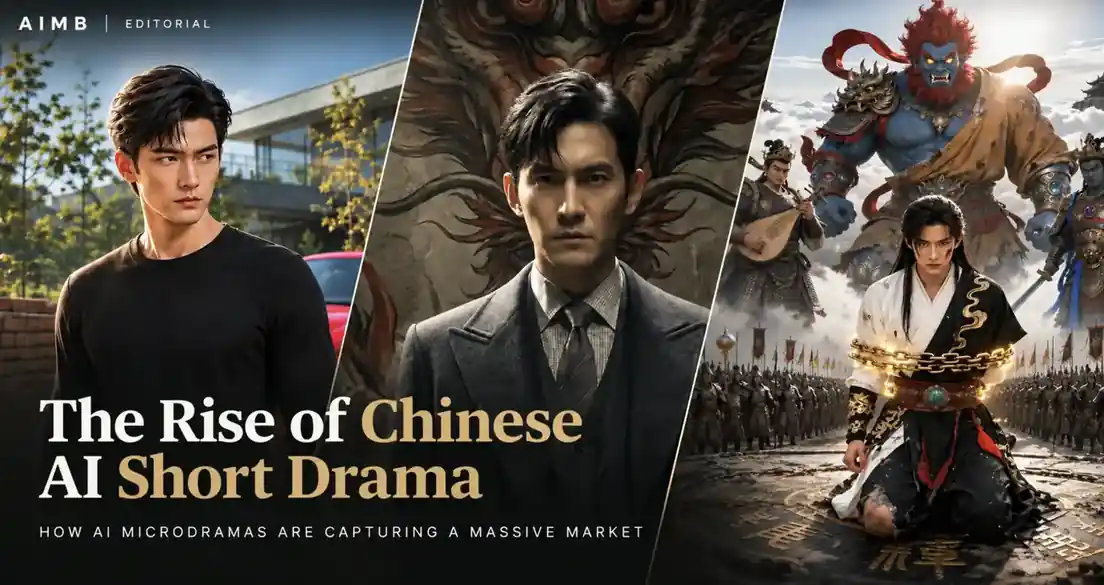
The Rise of Chinese AI Short Drama
China registered roughly 430,000 microdramas in the first eight months of 2026 alone — more than nine in ten of them AI-generated — but for most of those titles, turning views into profit is proving far harder than making the show.
China's short-drama industry didn't just grow in 2026 — its production method flipped. AI-generated titles now make up the overwhelming majority of a format that was already the country's fastest-growing form of video entertainment, and the volume is starting to outpace anyone's ability to say how many of these shows are actually worth watching.
AI Floods China's Microdrama Industry
At a briefing this September, China's National Radio and Television Administration reported roughly 430,000 microdramas registered in the first eight months of 2026 alone — about 13 times the full-year total for 2025 — with AI-generated titles accounting for more than nine in ten of them. The same briefing put the national microdrama audience at 851 million people, a bit over two-thirds of the country's internet users, and total spending on short dramas at over ¥100 billion ($14.9 billion) last year.
Platforms built around the format scaled to match: Hongguo, Douyin's dedicated short-drama app, reported roughly 600 million viewing sessions and 19.3 billion total views over this year's Lunar New Year period alone, with daily active users climbing past 160 million — more than double the figure from a year earlier. Those platform numbers don't separate AI-made titles from traditionally filmed ones, but they show the scale an AI-generated hit is now launching into.
The AI Dramas Behind the Numbers
Feng Shui Master, a supernatural series following a feng shui master fighting curses and evil spirits, reportedly passed 100 million views within 12 hours of its March 2026 premiere — an early episode pits him against a Shinto priest summoning giant serpents — and the show has since run to a fifth season. Immortal Execution Platform — AI Live-Action Version takes a different approach: built on a 2025 web-comic IP and rendered in a photoreal style built to pass for traditionally filmed drama, it follows a modern character pulled into a world of Chinese gods and immortals, and reportedly cleared 100 million views in six days. The Heart Inside the Steamed Bun went the other direction stylistically — an AI-animated comedy about rival steamed-bun shops, made in China's "AI 漫剧" comic-drama style rather than live action — and reportedly passed 1.3 billion views on Douyin. All three, along with more recent AI-generated Chinese titles, are in AIMB's catalog.
Why Chinese Studios Are Moving to AI
A traditionally filmed microdrama season still means hiring actors and booking sets, costumes and crew. AI generation cuts that cost sharply — trade coverage puts a standard live-action season at roughly ¥200,000 to ¥1,000,000, against an estimated ¥100,000 to ¥500,000 for an AI-generated one, depending on how visually complex the show is. For a studio trying to run several series at once, that gap matters: it can test a concept, a cast of characters or a setting without committing to a physical shoot first, across genres from romance and revenge to fantasy and historical epic. Lower cost doesn't guarantee a good business, though — it just lowers the bar to try.
| Production method | Estimated cost |
|---|---|
| Traditional live-action microdrama | ¥200,000 – ¥1,000,000 |
| AI-generated microdrama | ¥100,000 – ¥500,000 |
Industry estimates reported in Chinese trade coverage; AIMB has not independently verified them.
221,900 New AI Dramas — How Many Became Hits?
DataEye has tracked over 221,900 AI-generated short and comic dramas released on Chinese platforms in the first half of 2026 — and found that only 1,055 of them, about 0.47%, topped 100 million views. Chinese trade press has also pointed to a growing amount of recycled material: when a premise works, it tends to resurface under a new title with a lightly reshuffled plot. Lower production costs have pulled more studios into the market, and the resulting flood of content means a show now competes as hard for an audience's attention as it does to get made in the first place — plenty of AI dramas rack up millions of views without ever turning a profit.
China Is Already Tightening the Rules
China is set to tighten regulation of AI-made microdramas starting in September 2026, with new rules requiring clearer on-screen disclosure that a title used AI and restricting the use of a real person's face or voice without their consent. Regulators have said they'll continue to support dramas made with human casts and crews. There's nothing inherently wrong with AI-made content, but the volume now being produced raises real questions around copyright and jobs in the traditional industry — and making a show is a much lower bar than making one people actually want to watch.
What Comes Next?
China looks likely to remain the largest market for AI-generated series, and the same tools now driving domestic volume — synthetic performers, AI animation, compressed production timelines — could make it cheaper to adapt Chinese short dramas for audiences abroad. Whether the format reaches that scale internationally is still an open question, and AIMB doesn't expect many genuine creative landmarks to come from AI-generated drama in the near term. What's more likely, and more interesting, is a smaller set of filmmakers using these tools to tell a story actually worth telling — which is what AIMB's own Chinese AI Short Drama coverage is trying to track, not just which shows happened to use AI.
Editorial note: AIMB hasn't independently audited the viewership, spending or cost figures above — they're drawn from regulator briefings, platform reporting and Chinese trade press, not a verified third-party measurement standard, and the short-drama industry doesn't yet have one.
Independent AI cinema coverage More from the Journal →